


The global interest rate landscape is shifting, and central banks are sounding increasingly cautious. In his latest insight, our Chief Investment Officer, Jeff Brummette, explores what lies behind this change in tone, from persistent inflation and higher energy prices to surprisingly resilient economic growth and differing conditions across the world’s major economies. He considers what this means for the path of monetary policy ahead, and whether markets may need to rethink their expectations for interest rates in the months to come. Read the full article below for Jeff’s perspective on this evolving global backdrop.
_______
The European Central Bank (ECB), U.S. Federal Reserve (Fed), Bank of England (BoE) and Bank of Japan (BoJ) have all held policy meetings this month and one message is becoming clear: the mood of central bankers has shifted.
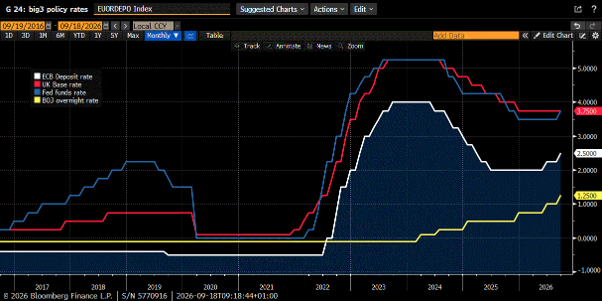
At the start of this year, the prevailing market view was that the Fed and the BoE would cut rates by 50 basis points, the ECB would likely remain on hold, and the BoJ would very gradually raise rates. Instead, the trajectory has changed meaningfully.
With its increase last week, the ECB has lifted rates twice delivering a cumulative 50 basis points of tightening. The Fed has just hiked for the first time this year after cutting rates by 175 basis points between September 2024 and December 2025. While the BoE left rates unchanged at its latest meeting, policymakers strongly hinted that a rate hike was coming. Meanwhile, the BoJ raised rates by 25 basis points, continuing its cautious but steady move away from ultra loose monetary policy.
Central Bank Policy Rates
Source: Bloomberg Finance L.P.
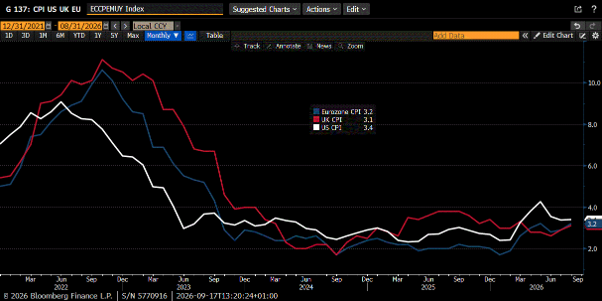
What has brought about this change in outlook and behaviour? The primary reason is simple: inflation remains stubbornly above the 2% targets set by most major central banks.
Levels of Inflation (Headline CPI)
Source: Bloomberg Finance L.P.
The conflict in the Middle East and the resultant rise in energy prices has been the main catalyst. Initially, central banks were content to look through the rise in energy prices as a temporary shock. However, with the conflict now more than six months old, that view is changing.
Central bankers have increasingly highlighted concerns that sustained energy price increases could eventually feed into broader inflation and inflation expectations.
The resilience of economic growth has also contributed to the change in stance. Both the ECB and the Fed acknowledged that economic activity has been stronger than expected, supported by robust labour markets and healthy levels of consumer spending.
Fed Chair Warsh highlighted the ongoing strength of domestic spending and continued investment in AI related infrastructure.
The BoE refrained from raising rates, citing softness in the UK labour market and the modest growth in wages.
Japan presents a different picture entirely. The BoJ is contending with rising wages, improving economic growth and a supportive fiscal backdrop. Persistent weakness in the yen is also weighing on their thinking. BoJ Governor Ueda suggested their monetary policy would become more pre-emptive, although markets remain sceptical that rates will rise substantially from current levels.
Importantly, today’s environment bears little resemblance to the aggressive period of tightening in 2021 to 2022.
At that time, central banks were confronted with a sharp surge in inflation and had to pivot from extremely accommodative policies to restrictive policy. The Fed and BoE, for example, took rates from close to zero to around 5% within little more than a year.
The current challenge is more nuanced. We are looking at inflation that is modestly but persistently above target, with growth generally firm and an energy shock adding to the mix. One way to think about the current cycle is that policymakers may seek to reverse a portion of the rate cuts delivered during 2024 and 2025 rather than embark on an entirely new tightening campaign.
The outlook remains highly dependent on developments in the Middle East and the broader global economy.
Should the conflict ease and energy prices stabilise, inflationary pressures would likely moderate, reducing the need for further policy tightening. Equally, if economic growth begins to slow materially, central banks may conclude that current policy settings are sufficiently restrictive.
For now, however, policymakers appear united by a common concern: inflation has proved more persistent than expected, and the era of rate cuts that markets anticipated at the beginning of the year has, at least temporarily, been put on hold.
The price and value of investments and any income that might accrue may fall as well as rise and is not guaranteed. You may not get back the amount of your original investment.
_______
Hear more from the Oakglen experts
Our investment team continue to provide interesting and informative content to help keep you in the loop on recent global news and market trends. See below for some key highlights from around the world which our Chief Investment Officer has also recently covered:
Read more:
- September 2026 Investment Summary
Jeff Brummette, Chief Investment Officer
- Quarter 2 2026 Investment Update
Jeff Brummette, Chief Investment Officer
- August 2026 Investment Summary
Jeff Brummette, Chief Investment Officer
You can read other articles from the team on our News & Insights page.
Sign up below to receive similar content directly into your inbox.
Want to become an Oakglen client?
Get in touch with one of our wealth team via the Contact Us page to hear more about our products and services, and how suitable they are for you and your personal circumstances.