


July proved to be another month in which markets were shaped by a rapidly changing mix of geopolitical developments, shifting expectations for interest rates and continued debate around the sustainability of the technology-led rally. Against this backdrop, investors were faced with renewed volatility across several asset classes, while corporate earnings provided a more constructive counterpart. In this month’s update, our Chief Investment Officer, Jeff Brummette, reflects on the key developments of July, considers what they mean for markets and portfolios, and looks ahead to the themes that may shape the months to come.
_______
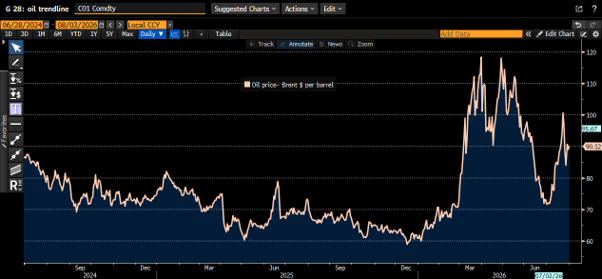
Hope of a peace deal between the United States and Iran faded in early July, with conflict resuming in the middle of the month. Iran targeted shipping and U.S. military facilities across the region. The U.S. responded with strikes against a variety of Iranian military targets near the Strait of Hormuz and halted the movement of Iranian oil tankers through the Strait.
The market reactions were as one would have expected. The price of Brent crude briefly rose to $100 per barrel for Brent, while equity and bond markets sold off.
Oil Price ($/barrel)
Source: Bloomberg Finance L.P.
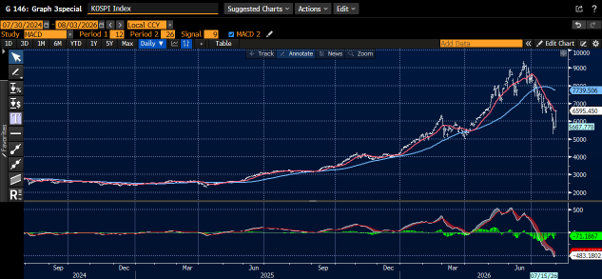
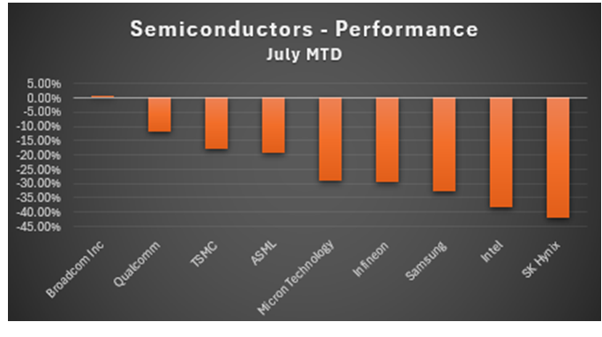
The AI chip sector continued to retreat following its significant gains during the second quarter. SK Hynix, the South Korean chipmaker whose IPO of their U.S. listed ADR was the largest ever foreign IPO on record, has fallen 24% since its July 9th launch. Its South Korean listed shares declined even more. The wider South Korean equity market has also seen a dramatic reversal, as levered retail investors have had a torrid month.
The Korea Composite Stock Price Index
Source: Bloomberg Finance L.P.
Semiconductors – July Performance (as of 31.07.2026)
Source: Oakglen Wealth via Bloomberg
By the end of the month, peace had broken out with President Trump suggesting that an agreement remained possible although Iran denied that talks were taking place. In response, Brent crude oil fell to around $85 a barrel.
Equity markets remained mixed as indices with significant AI exposure, including the NASDAQ, Nikkei 225 and the KOSPI, recorded losses on the month while Europe and the UK showed modest gains.
Fixed income markets produced negative returns as fears of higher inflation and ever rising government deficits pushed yields higher.
Equity Markets
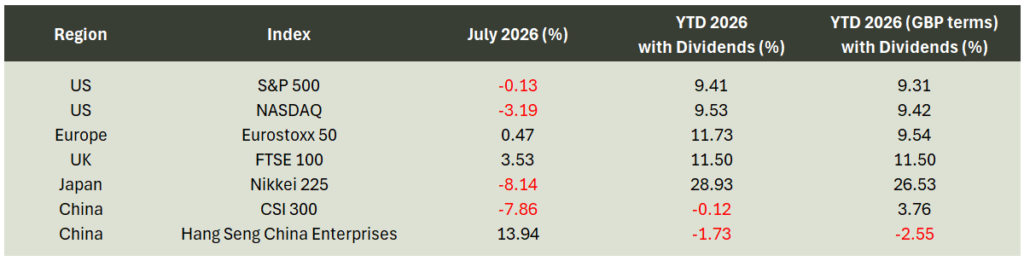
Index returns are in local currency terms except where noted
Source: Bloomberg
Fixed Income Markets

Source: Bloomberg
Alternative Investments Markets
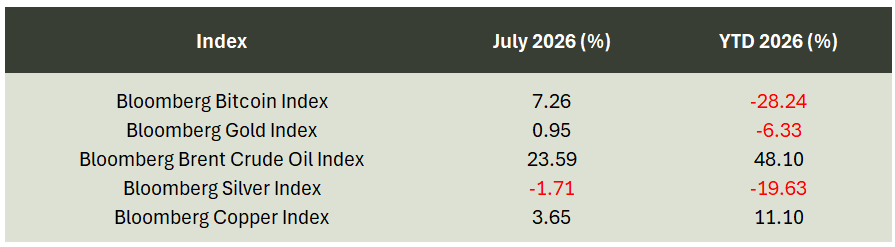
Commodity returns are versus the U.S. dollar
Source: Bloomberg
Currency Rates
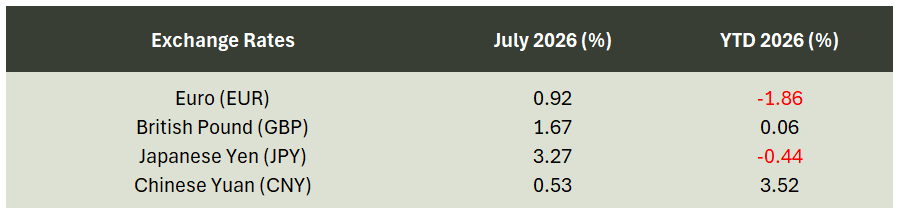
Exchange rate changes are versus the U.S. dollar
Source: Bloomberg
UK and U.S. Ten-Year Government Bond Yields
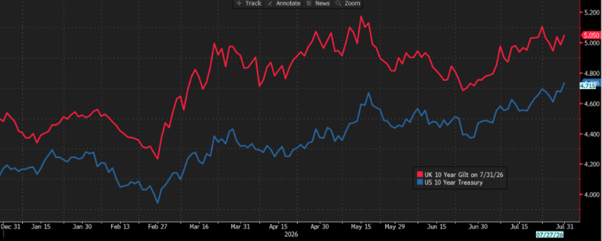
Source: Bloomberg Finance L.P.
Despite the volatility in equities and energy markets, gold, silver and Bitcoin were relatively subdued with limited movement over the month.
Our portfolios benefited from their diversification. Energy, defence, financials and health care performed strongly during July, helping to offset weakness across parts of the AI and technology sectors.
The major central banks all left policy unchanged. They, like market participants, struggled to makes sense of the volatility in energy prices and the potential second order effects on inflation and inflation expectations.
New U.S. Federal Reserve Chair Kevin Warsh held his second press conference but provided little additional clarity on the future direction of monetary policy. U.S. bond yields continued to nudge higher. Indeed, Chair Warsh appeared relatively comfortable with this development, suggesting that tighter financial conditions could reduce the extent to which the Federal Reserve itself needed to act.
Yields rose in the UK as concerns over new Prime Minister Andy Burnham’s spending plans unsettled markets. European yields also moved higher, particularly at the longer end of the curve, as the combination of ever rising social spending and sharply rising defence spending raised concerns about future government borrowing requirements.
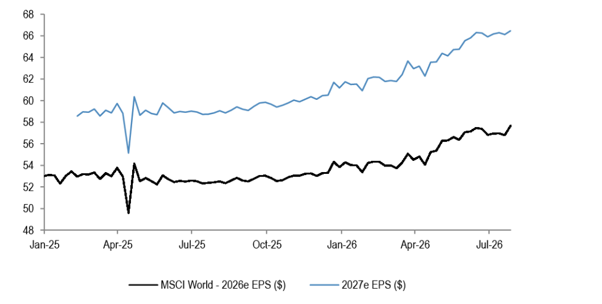
Despite volatility in energy prices and the steady rise in interest rates, corporate earnings have remained strong.
Q2 2026 Earnings Results
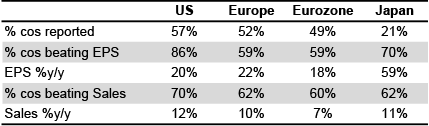
Source: Bloomberg Finance L.P., J.P. Morgan
MSCI World 2026e and 2027e EPS
Source: IBES
We expect continued investment in technology, defence and power generation to support economic activity and corporate earnings over the coming months. Labour markets remain firm and while inflation is still above target levels, the central banks are patient and will be measured in their attempts to reign it in.
The price and value of investments and any income that might accrue may fall as well as rise and is not guaranteed. You may not get back the amount of your original investment.
_______
Hear more from the Oakglen experts
Our investment team continue to provide interesting and informative content to help keep you in the loop on recent global news and market trends. See below for some key highlights from around the world which our investment team have also recently covered:
Read more:
- SpaceX’s $75bn Bet on the Future Faces a Reality Check
William Lamond, Investment Director
- July 2026 Investment Summary
Jeff Brummette, Chief Investment Officer
- Quarter 2 2026 Investment Update
Jeff Brummette, Chief Investment Officer
You can read other articles from the team on our News & Insights page.
Sign up below to receive similar content directly into your inbox.
Want to become an Oakglen client?
Get in touch with one of our wealth team via the Contact Us page to hear more about our products and services, and how suitable they are for you and your personal circumstances.