


Markets experienced a notable shift during the second quarter of 2026, with improving investor sentiment driving a broad recovery across many asset classes despite ongoing geopolitical tensions and economic uncertainty. While the backdrop remains complex, developments over the quarter reinforced the importance of maintaining a disciplined, long term investment approach in an environment shaped by changing monetary policy, evolving global risks and powerful structural growth themes.
In this Q2 2026 Investment Update, our Chief Investment Officer, Jeff Brummette, reflects on the key market developments of the quarter, explores the factors influencing portfolio positioning, and shares his outlook for the months ahead.
_______
The second quarter marked a sharp reversal in financial markets following the sell off seen in March. Risk assets recovered strongly as investors moved from pricing an extended geopolitical and energy shock to pricing a more manageable, albeit still fragile, outcome in the Middle East. The improvement in sentiment was powerful, with the S&P 500 and Nasdaq delivering their strongest quarterly gains since 2020, helped by a significant rally in semiconductor shares, while Japanese equities also advanced to new highs.
Semiconductors – Q2 2026 Performance
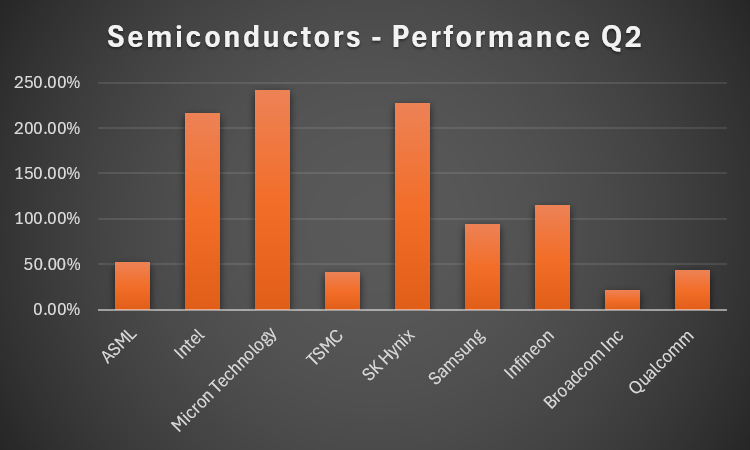
Source: Oakglen Wealth via Bloomberg
Equity Markets

Index returns are in local currency terms except where noted
Source: Bloomberg
The catalyst for the rally was not the removal of geopolitical risk, but the perception that the worst-case scenario had become less likely. The conflict involving Iran had caused major disruption in energy markets and global shipping, particularly through the Strait of Hormuz. By the end of the quarter, a fragile ceasefire process and renewed diplomatic efforts had helped markets look through some of the immediate disruption. However, shipping volumes remained well below pre conflict levels and the situation in the Strait of Hormuz remained sensitive.
Strait of Hormuz Daily Ship Crossings

Source(s): AIS and vessel movement data suppliers are IHS
Fixed income markets delivered a more uneven recovery. Government bond yields remained under pressure as investors reassessed the outlook for inflation and monetary policy. At the start of the year, markets had expected the U.S. Federal Reserve (“Fed”) to continue cutting rates. By the end of the quarter, that expectation had shifted materially, with investors instead contemplating the possibility that policy could remain restrictive for longer or even tighten again if inflation proved persistent.
Fixed Income Markets

Source: Bloomberg
Newly appointed Fed Chair Kevin Warsh proved less dovish than many investors had expected, and less accommodative than the White House may have hoped. While the Federal Open Market Committee left rates unchanged, the tone of the meeting was more hawkish than earlier in the year. The updated projections pointed to a higher path for policy, with the median year end rate forecast rising to 3.8%. Warsh’s decision not to submit his own dot plot also added to the impression that the Fed may become less explicit in its forward guidance, increasing the risk of greater volatility across both bond and equity markets.
Commodities were volatile, with oil the key focus. Crude prices fell back from the March spike as ceasefire hopes improved, but supply and shipping conditions remained tight, particularly around the Strait of Hormuz. Gold, silver and bitcoin weakened as higher yields and a firmer U.S. dollar reduced demand for precious metals and other alternative stores of value. Copper was more resilient, supported by supply constraints and longer-term demand from electrification, infrastructure and AI related power needs.
Oil Price ($/barrel)

Source: Bloomberg Finance L.P.
Commodities Price ($/oz)

Source: Bloomberg Finance L.P.
Alternative Investments Markets

Source: Bloomberg
AI remained the dominant structural theme. The scale of planned AI capital expenditure is now large enough to influence not only company level earnings expectations but also broader economic growth, energy demand, power infrastructure, credit issuance and investor sentiment. The clearest beneficiaries were semiconductor companies and other infrastructure providers, where investors could see a direct link between AI spending and revenue growth. As we look ahead to the second half of the year, we expect AI spending to remain a major influence on growth and equity market performance.
AI Capex (Last 12 months actual and estimates)

Source: J.P. Morgan Equity Strategy & Quantitative Research,
Bloomberg Finance L.P., FactSet
This extraordinary scale of capital expenditure is being driven by rapid growth in demand for computing power to train and run AI models. Companies such as Anthropic and OpenAI continue to see strong revenue growth as their user bases expand and usage intensity increases. The key question for markets is whether this spending translates into durable revenue growth and productivity gains, or whether investors become more concerned about the scale of investment required.
UK assets were affected by renewed domestic political uncertainty. Prime Minister Keir Starmer announced his resignation in late June, paving the way for the UK’s seventh Prime Minister since the 2016 Brexit referendum. The immediate market reaction was relatively contained, with sterling weakening modestly and gilt yields remaining elevated, suggesting investors had already begun to price in a leadership change. The more important issue for markets is not the change of Prime Minister itself, but whether it creates uncertainty around fiscal policy, public spending, borrowing and the broader direction of economic management. The experience of the Liz Truss period remains a clear reminder that UK assets can reprice quickly when investors lose confidence in fiscal credibility.
European markets delivered a more uneven quarter. Equities were supported by cheaper valuations, improving earnings expectations and fiscal spending plans, particularly in Germany, but subdued growth, geopolitical uncertainty and weaker external demand remained headwinds.
Japan was a standout market, with equities reaching new highs as AI and semiconductor demand supported investor sentiment. The domestic backdrop also improved, helped by wage growth, resilient consumption and stronger corporate investment. However, inflation remains above target, and the Bank of Japan is expected to continue normalising policy, making the yen and Japanese bond yields key risks. The long-term case remains supported by governance reform and improving capital discipline, although earnings delivery will matter more after such a strong rally.
Looking ahead, the key question is how central banks respond to improving growth while inflation remains above target. We do not expect immediate action to raise rates, but we do expect policymakers to remain cautious. The Fed is likely to wait and assess whether the recent reversal in oil prices helps bring inflation closer to target. The European Central Bank will also want to see whether lower energy prices feed through into inflation, while the Bank of England must consider both the impact of energy prices and the potential implications of UK fiscal policy following the Labour leadership transition.
Although we do not expect central banks to tighten policy in the near term, we continue to see upward pressure on longer term interest rates. AI capital expenditure is increasingly being funded through debt issuance, at the same time as fiscal deficits remain elevated, defence spending is rising sharply, and energy and materials companies require significant investment. Against this backdrop, it is difficult to see fixed income delivering returns materially above running yields.
Defence spending is likely to continue rising globally as countries rebuild inventories following the conflict with Iran and as Europe seeks to reduce its reliance on the U.S. for defence. We continue to hold significant exposure to defence related companies in portfolios.
Negotiations between the U.S. and Iran remain volatile. At best, we expect an awkward peace, with the risk of occasional disruption around the Strait of Hormuz and a structurally lower level of transits than before the conflict. Gulf nations are likely to work hard to find alternative energy export routes that reduce reliance on the Strait. We increased energy exposure during the conflict and expect this to remain helpful in a more volatile energy price environment.
During the quarter, we took some profits in technology and intend to add further alternative exposure, while reducing longer duration fixed income holdings. With the settlement of the Iran conflict still uncertain and the U.S. heading towards important midterm elections in November, financial market volatility is likely to remain elevated.
The price and value of investments and any income that might accrue may fall as well as rise and is not guaranteed. You may not get back the amount of your original investment.
_______
Hear more from the Oakglen experts
Our investment team continue to provide interesting and informative content to help keep you in the loop on recent global news and market trends. See below for some key highlights from around the world which our investment team have also recently covered:
Read more:
- July 2026 Investment Summary – Oakglen Wealth
Jeff Brummette, Chief Investment Officer
- SpaceX’s $75bn Bet on the Future Faces a Reality Check
William Lamond, Investment Director
- June 2026 Investment Summary
Jeff Brummette, Chief Investment Officer
You can read other articles from the team on our News & Insights page.
Sign up below to receive similar content directly into your inbox.
Want to become an Oakglen client?
Get in touch with one of our wealth team via the Contact Us page to hear more about our products and services, and how suitable they are for you and your personal circumstances.