


The latest policy moves from the world’s major central banks highlight diverging approaches to balancing inflation risks with mounting signs of economic softness. In this article, our Chief Investment Officer, Jeff Brummette, examines the Federal Reserve’s recent rate cut and its implications for global markets, while also considering the contrasting stances of the European Central Bank and the Bank of England. The discussion sets the stage for how investors might interpret monetary policy shifts in the months ahead.
_______
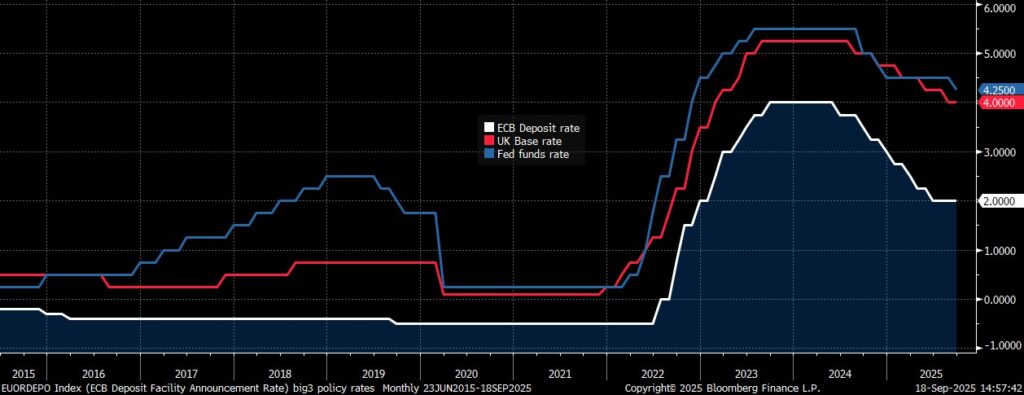
As expected, the U.S. Federal Reserve Bank (Fed) lowered interest rates by 25-basis point on 17 September. Stephen Miran, the newest member of the Federal Open Market Committee, voted against the cut as he (and President Trump?) wanted a 50-basis point move. More importantly, the Fed’s projections indicated two additional rate cuts are likely before year-end, even as inflation is expected to rise next year and unemployment remains steady.
Federal Open Market Committee (FOMC) Projections
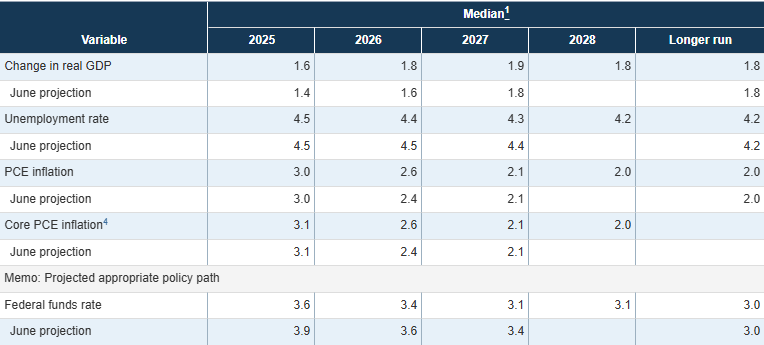
Source: FRB Website (September 17, 2025: FOMC Projections)
Chairman Powell highlighted downside risks to the labour market as justification for the rate cut, noting the unusual situation that both the labour supply and the demand were falling at the same time. He also suggested that the Fed’s base case was that tariffs would produce a one-off upward shift in the price level rather than having a sustained long-term impact on inflation, but he acknowledged they couldn’t be sure and it was a risk that had to be managed.
From our perspective, the Fed is more worried about labour market weakness than inflation, which remains closer to 3% than the 2% target. Their comfort in easing policy under these conditions is likely to keep downward pressure on the U.S. dollar and unsettle long-term bonds. It may help equities unless the market decides the rate cuts are too late, and the economy is slipping into a recession. This will become apparent as we see more labour data.
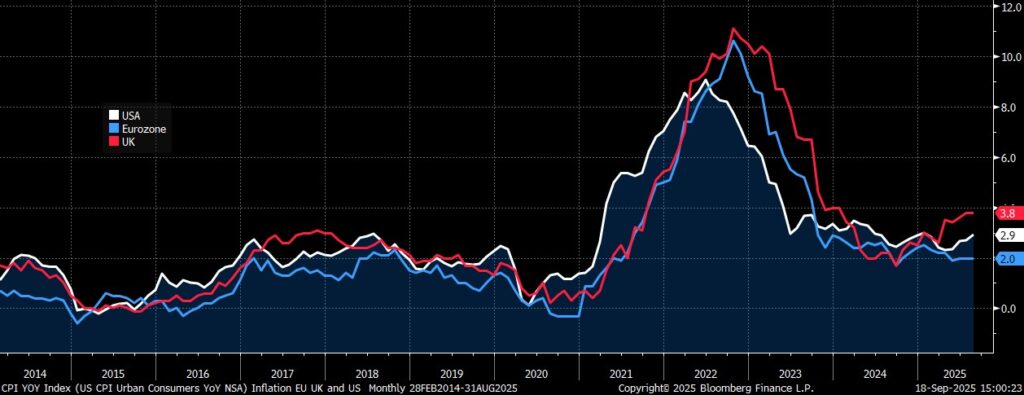
In contrast, the European Central Bank (ECB) left rates unchanged at 2% at their meeting last week, with inflation currently at their 2% target. The level of interest rates has come down significantly this year and is helpful to businesses and households. As such, the ECB sees no need for further action at this stage.
The Bank of England (BoE) is in a challenging spot. At its latest meeting today, they left rates unchanged at 4%. Inflation is close to 4% so they have chosen to move very slowly on lowering rates. While there is evidence the labour market is softening, wage gains remain at levels inconsistent with meeting a 2% inflation target. They did reduce the pace of shrinking their balance sheet (quantitative tightening) in an effort to reduce the upward pressure on longer term bond yields. Looking ahead, the upcoming budget will be a key determinant of future rate policy, depending on whether it leans more restrictive or stimulative.
For the remainder of the year, the Fed’s policy decisions are likely to have a greater impact on global financial markets than those of the ECB or the BoE. Notably, rising inflation in both the U.S. and UK has not deterred central banks from easing policy, underscoring the growing concern over labour market softness and broader economic momentum.
EU, UK and U.S. CPI
Source: Bloomberg Finance L.P.
EU, UK and U.S. Policy Rates
Source: Bloomberg Finance L.P.
_______
Hear more from the Oakglen experts
Our investment team continue to provide interesting and informative content to help keep you in the loop on recent global news and market trends. See below for some key highlights from around the world which some of the investment management team have recently covered:
Read more:
- A Merger of Equals: Anglo American and Teck Resources Combine
William Lamond, Investment Director (Jersey)
- US Tariffs: Here to stay?
Jeff Brummette, Chief Investment Officer
- H1 2025: Discretionary Investment Management Service Update
Myles Renouf, Senior Investment Manager
- July 2025 Investment Summary
Jeff Brummette, Chief Investment Officer
You can read other articles from the team on our News & Insights page.
Sign up below to receive similar content directly into your inbox.
Want to become an Oakglen client?
Get in touch with one of our wealth team via the Contact Us page to hear more about our products and services, and how suitable they are for you and your personal circumstances.