


It remains as important as ever for us as a business to reflect on our investment performance and the ongoing strategic decision-making process of our team. In this update, Myles Renouf, Senior Investment Manager at Oakglen Wealth, reflects on the third quarter of 2025, set against a backdrop of persistent geopolitical tensions, evolving monetary policy expectations and continued market outperformance.
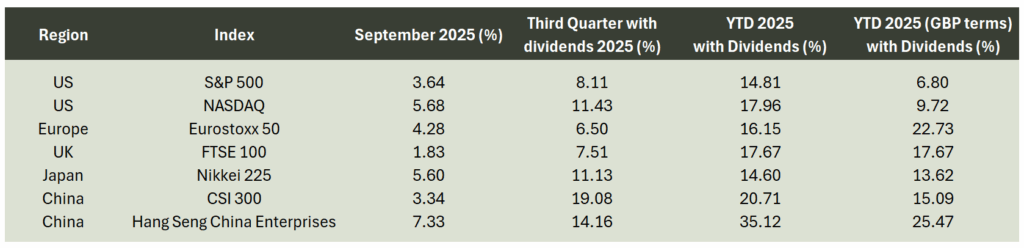
Global equities rallied strongly, with both the S&P 500 and Nasdaq Composite reaching record highs. Small-cap stocks outperformed their large-cap counterparts for the first time in several quarters. This shift was driven by rising expectations of further monetary easing, which tends to benefit smaller companies more due to their heightened sensitivity to borrowing costs and domestic economic trends. As the outlook improved, these firms saw outsized gains.
European equities also advanced in Q3, driven by macroeconomic stabilisation, including 1.2% Eurozone GDP growth, falling inflation and European Central Bank (ECB) rate cuts, which particularly boosted sentiment among the industrial and financial sectors.
In the UK, the Bank of England reduced its base rate to 4.0%. Real wage growth, resilient household balance sheets, and a recovery in discretionary spending contributed to a more constructive outlook. However, the forthcoming Autumn Budget and the potential for increased taxation may cast a shadow over the domestic market in the final quarter of the year.
Chinese equities rebounded strongly in Q3, led by technology and high-end manufacturing stocks. Stimulus measures, easing trade tensions with the U.S., and policy support for domestic chipmakers fuelled the rally.
Equity Markets
Source: Bloomberg
Fixed income markets posted mixed results over the quarter. In the U.S., Treasury prices rose, supported by a Federal Reserve rate cut and narrowing credit spreads. In contrast, UK fixed income underperformed, with the Bloomberg Sterling Aggregate Index delivering a negative return amid persistent concerns over the sustainability of the public sector deficit. European bond markets were more nuanced: shorter-dated maturities benefited from the European Central Bank’s increasingly flexible policy stance, while elevated issuance levels and concerns over fiscal deficits pushed long-term yields higher, steepening the mid-to-long end of the curve.
Fixed Income Markets

Bloomberg Aggregates Total Returns Indices
Source: Bloomberg
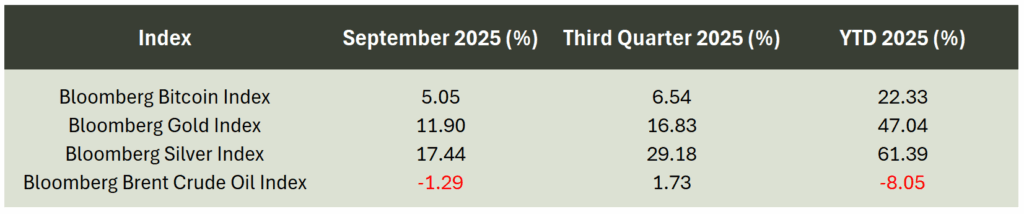
Gold maintained its upward trajectory during the quarter, supported by continued central bank purchases and robust seasonal demand. However, its performance was eclipsed by silver, which rose by over 29%, driven by surging industrial demand – particularly from the solar, electric vehicle, and electronics sectors – tight supply conditions, and strong investor interest, as inflows into silver ETFs reached record highs.
Alternative Investments Markets
Source: Bloomberg
Our discretionary strategies delivered strong relative performance over the course of the third quarter of 2025:
- Diversify Strategy (medium risk): Delivered a return of +6.28% in Q3 2025, outperforming the ARC Sterling Balanced Asset PCI peer group, which returned +4.04%. Since inception (31 December 2019), the strategy has achieved a total return of +41.34%, significantly ahead of the peer group’s +21.86% return over the same period.
- Grow Strategy (high risk): Returned +8.66% in Q3 2025, also ahead of the ARC Sterling Equity Risk PCI, which posted a +6.20% return. Since inception, Grow has delivered a cumulative return of +64.53%, comfortably outperforming the peer group’s +34.05%.
Figures refer to past performance. Past performance is not a reliable indicator of future performance. The value of your investment, and any income from it, can fall as well as rise. Your capital is at risk and you may get back less than you have invested.
Key Themes from Our H2 2024 Outlook – Progress in H1 2025
1. Defence Spending
Defence budgets continued to rise sharply in Q3 2025, particularly across Europe, as geopolitical tensions remained elevated. Germany reaffirmed its commitment to reach 3.5% of GDP by 2029, while EU-wide defence spending is projected to hit over €380 billion this year. This sustained fiscal commitment across the continent underpins the long-term growth potential of the defence sector, with our positioning towards European defence firms as a radically aligned core holding within this macro theme.
2. Mega-Cap Tech Resurgence
Mega-cap tech stocks extended their rally in Q3, driven by record-breaking earnings and AI infrastructure demand. Nvidia posted a 94% year-on-year revenue increase, with its data centre segment alone generating over $30 billion. Microsoft, Meta and Broadcom also delivered strong double-digit gains, supported by cloud and AI momentum. The “Magnificent Seven” continued to lead market performance, though elevated valuations prompted more selective positioning among our exposure to broader AI enablers such as networking, storage, optical and hard disc drive as well as expansion into wider AI infrastructure including power and cooling.
3. Foreign Exchange Volatility
FX markets remained volatile in Q3. The U.S. Dollar weakened further, pressured by fiscal concerns, Fed rate cut expectations, and political uncertainty. Sterling held firm, supported by investor rotation out of U.S. dollar assets. The Euro appreciated, buoyed by falling inflation and the ECB’s pause in rate cuts. Diverging central bank trajectories and persistent geopolitical risks continue to drive currency market fluctuations. With volatility likely to persist into Q4, we maintain an underweight position in the U.S. Dollar, anticipating further downside ahead.
4. Economic Policy Divergence
Governments (politicians) remain unwilling or unable to reduce spending, leaving inflation and currency devaluation as the way to deal with their ever-growing debt. Since currencies cannot all devalue at the same time – except against gold (and perhaps silver) – this dynamic appears to be unfolding. While cryptocurrencies may benefit on the margins, central banks and institutional investors will primarily buy gold. The longer maturities of most developed country bond markets are evidencing the same concerns as yield curves steepen around the world. Refinancing existing debt into current levels of interest rates is only increasing the burden of most governments budgets. When this becomes a crisis is not predictable, but it is inevitable without substantial reductions in entitlements in most Western nations. Yet, in the near term, fiscal restraint is absent from policy agendas. We remain positioned at the shorter end of the yield curve, specifically within the 3-to-7-year segment. This area is expected to benefit from potential short-term interest rate reductions, while also helping to mitigate downside risk should inflation reaccelerate and central banks reassess the trajectory of policy rates. At the same time, it continues to offer an attractive yield relative to current rate levels.
To find out more about our discretionary investment management services, please contact the below:
Jersey
| Jersey@oakglenwealth.com | |
| Tel | +44 (0) 1534 789 942 |
UK
| UK@oakglenwealth.com | |
| Tel | +44 (0) 20 4583 1118 |
Capital may be at risk.
The price and value of investments and any income that might accrue may fall as well as rise and is not guaranteed. You may not get back the amount of your original investment.
The ARC Private Client Indices are determined by Oakglen Wealth to be the most suitable benchmark for comparison purposes only. It must be noted that the last 3-month performance figures may be based on ARC estimates and may be subject to revision.
Further information can be found here: www.suggestus.com