


April delivered a sharp rebound across global markets as easing geopolitical tensions and renewed momentum in artificial intelligence investment lifted investor sentiment. Equities rallied strongly, led by technology and semiconductor companies, while developments in energy markets and central bank policy continued to shape the broader macroeconomic backdrop. Beneath the recovery, however, significant uncertainty remains. Fragile negotiations in the Gulf, rising inflationary pressures and growing concerns over energy supply are creating an increasingly complex environment for policymakers and investors alike. Against this backdrop, long-term structural themes including defence spending, AI infrastructure and energy security continue to drive capital allocation and market leadership. In this month’s update, our Chief Investment Officer, Jeff Brummette, takes a closer look at what has been going on.
_______
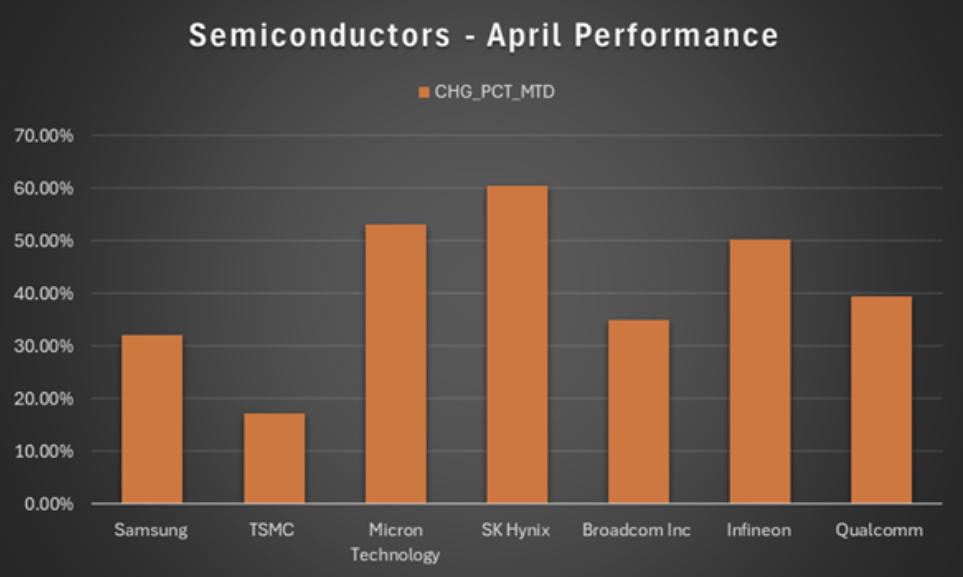
The announcement of a ceasefire between Iran and the U.S. and Israel on the last day of March set the stage for a powerful rally for global equities in April. U.S. technology and global chip manufacturers led the move. Japanese equities also rallied sharply, with the Nikkei 225 benefitting from growing recognition that many Japanese manufacturers are critical suppliers to the global AI infrastructure build out.
Equity Markets
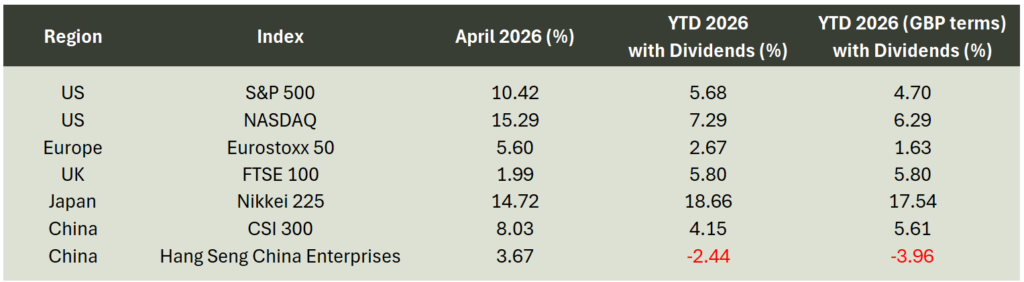
Index returns are in local currency terms except where noted
Source: Bloomberg
Fixed Income Markets

Source: Bloomberg
Alternative Investments Markets
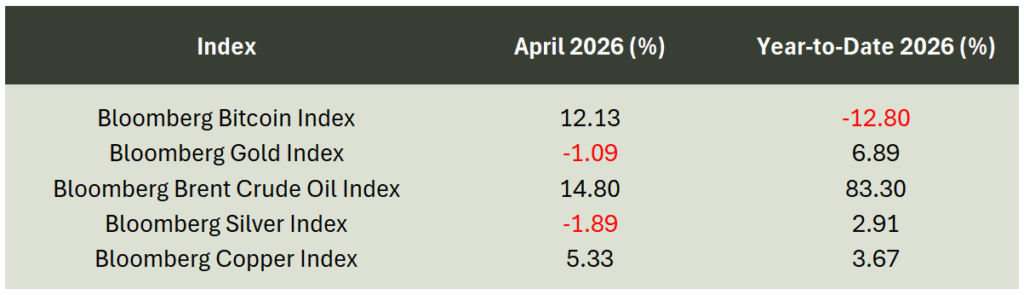
Commodity returns are versus the U.S. dollar
Source: Bloomberg
Currency Rates
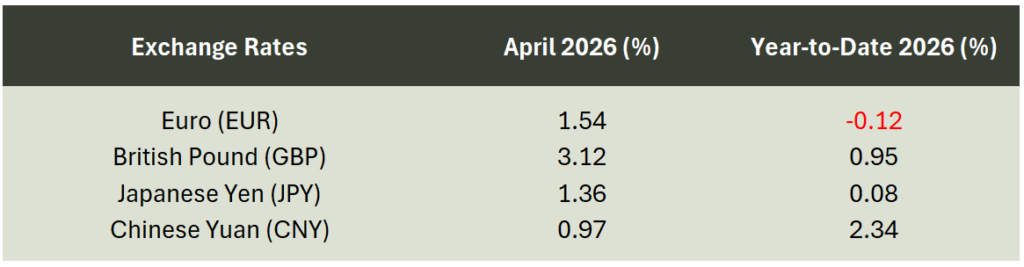
Exchange rate changes are versus the U.S. dollar
Source: Bloomberg
Oil prices stabilised, albeit at elevated levels. Fixed income markets, however, did not recover losses suffered in March as the latest inflation data rose, reflecting higher energy prices.
Inflation Levels

Source: Bloomberg Finance L.P.
The situation in the Gulf remains tense and highly fluid. Negotiations between the U.S. and Iran aimed at securing a permanent end to the war have stalled, with both sides holding entrenched positions. The U.S. is demanding Iran relinquish its enriched uranium and reopen the Strait of Hormuz. In turn, Iran is seeking reparations, guarantees against future attacks by the U.S. and Israel, and acknowledgment of its control over the Strait.
In practice, the Strait of Hormuz is effectively closed to most maritime traffic, with Iran threatening vessels that have not sought or paid for permission to transit. The U.S. has responded by blocking Iranian vessels from entering or departing the Strait, in an attempt to starve Iran of cash and force them to shut down their oil production as they run out of domestic oil storage facilities. It is not clear which party will blink first. For Iran, the stakes are existential. While the conflict is unpopular with the U.S. public, President Trump retains the support of the Republican party, which controls both houses of Congress. With midterm elections still six months away, Trump may judge that he has scope to wait in the hope that economic pressure destabilises the Iranian regime.
Despite geopolitical tensions, recent U.S. economic data continues to point to resilient activity, with first quarter corporate earnings coming in stronger than expected.
U.S. Economic Growth Boosted by AI-Driven Business Investment
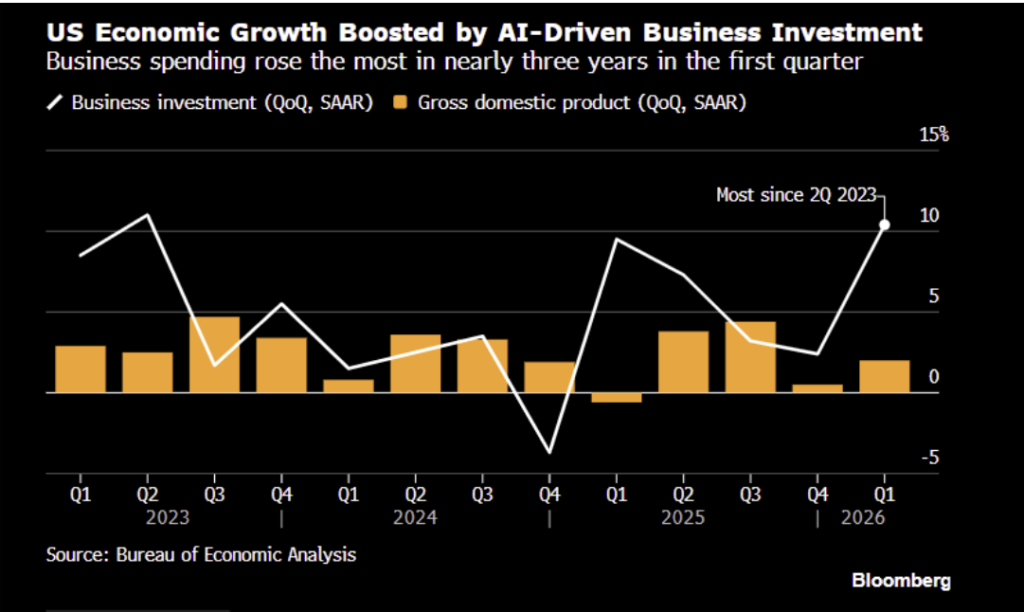
Source: Bureau of Economic Analysis via Bloomberg
2026 Q1 Earnings So Far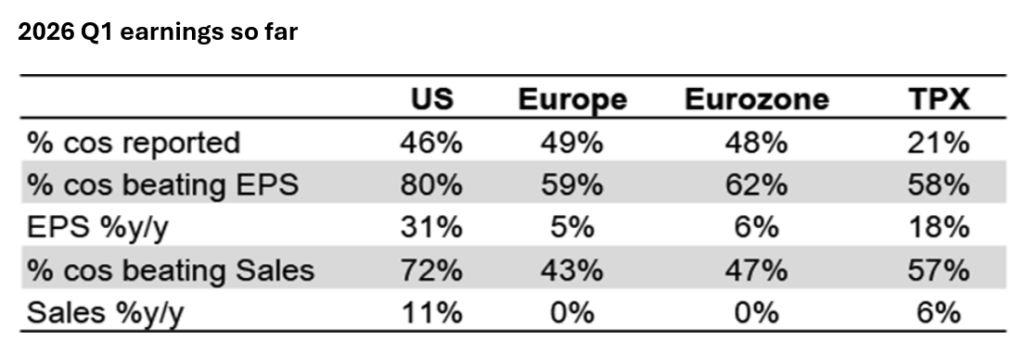 Source: Bureau of Economic Analysis via Bloomberg
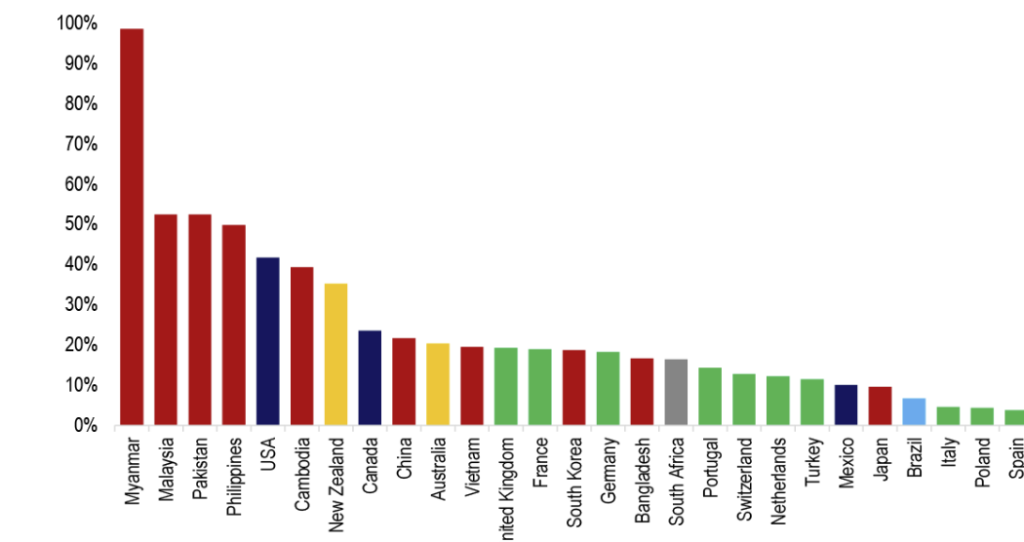
Elsewhere, the outlook is more concerning. Across the rest of the developed world, there are growing fears that physical shortages of jet fuel, diesel and petrol could emerge within the coming month.
Retail Gasoline Price Changes (February 2023 – April 2027)
Source: Bloomberg
Diesel Price Changes (February 2023 – April 2027)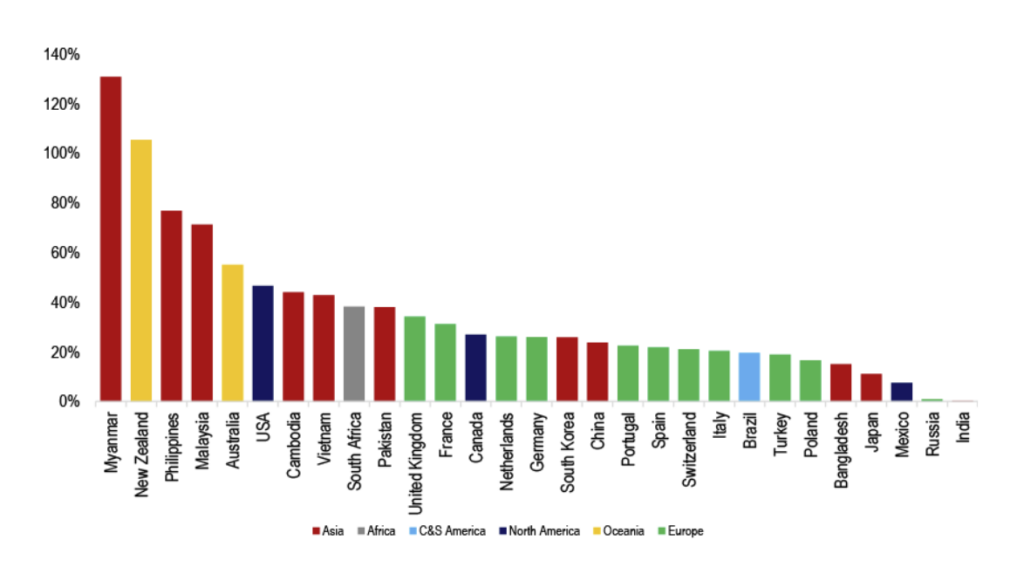 Source: Bloomberg
Central banks remain firmly in a wait and watch mode. The U.S. Federal Reserve Bank, the European Central Bank, the Bank of England and the Bank of Japan all held policy steady in April. Policymakers are assessing whether higher energy prices will lead to broader second round inflation effects or instead weigh on economic activity to the point where inflation pressures ease. All suggested they were poised to raise rates if needed.
This meeting marked Jerome Powell’s final one as Chair of the Federal Reserve. He is expected to be replaced by former Governor Kevin Warsh, who has been approved by the Senate Banking Committee and is awaiting confirmation by the full Senate. In a surprising move, Powell announced that he intends to remain on the Board of Governors, where his term runs until January 2028. Traditionally, Fed Chairs step down from the Board at the end of their term. His decision is widely seen as an effort to defend the independence of the Federal Reserve by limiting the President’s ability to appoint an additional, more politically aligned Governor.
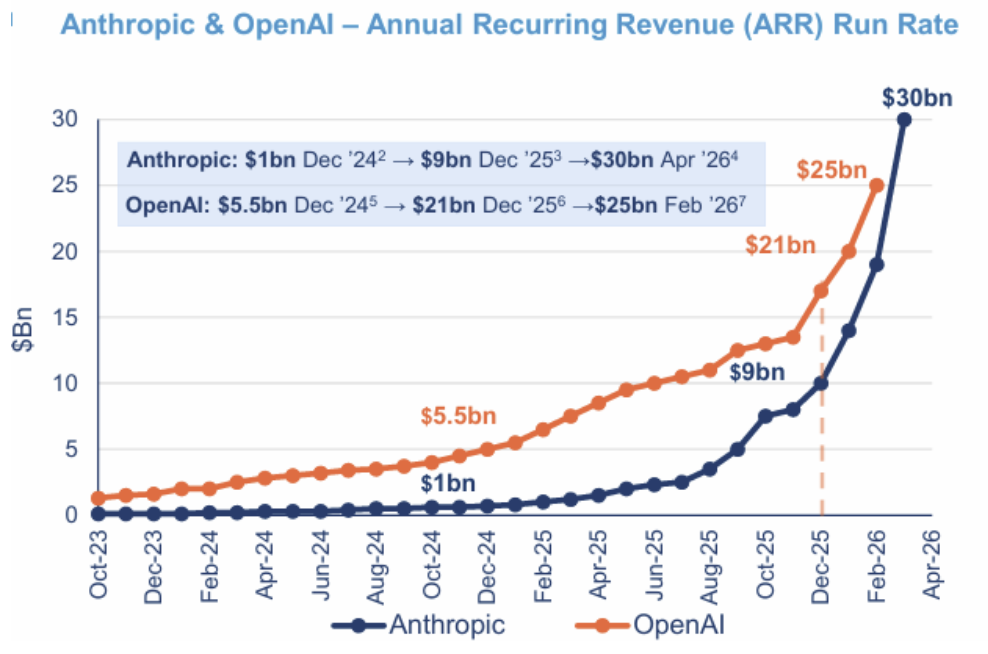
AI related investment continues to accelerate. Demand for computer power remains strong, with revenues at companies such as Anthropic and OpenAI rising rapidly alongside the share prices of the large hyperscalers.
Anthropic & OpenAI – Annual Recurring Revenue (ARR) Run Rate
Source: Bloomberg
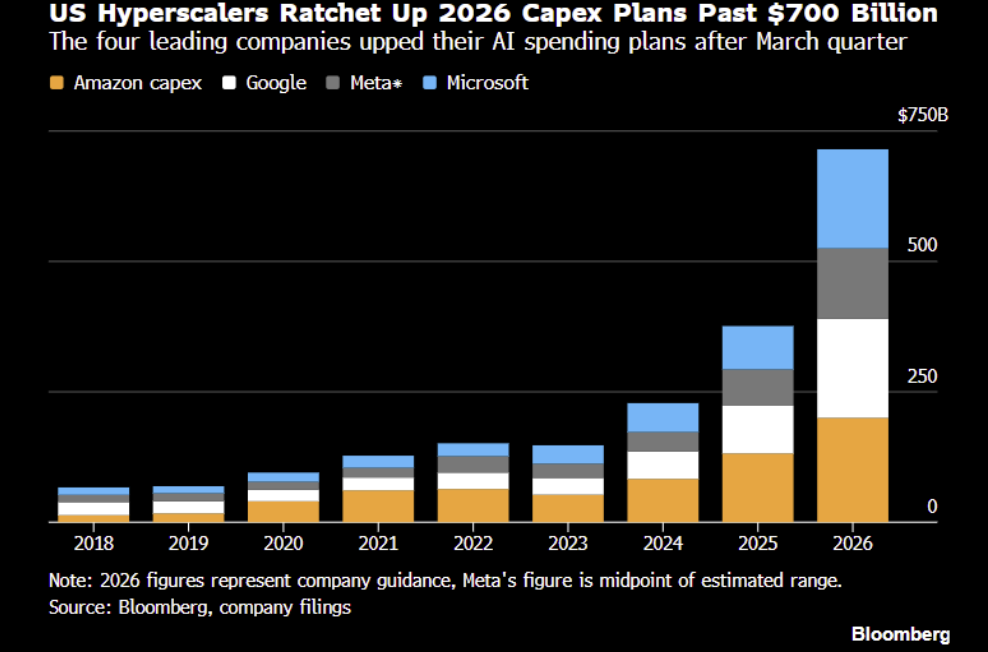
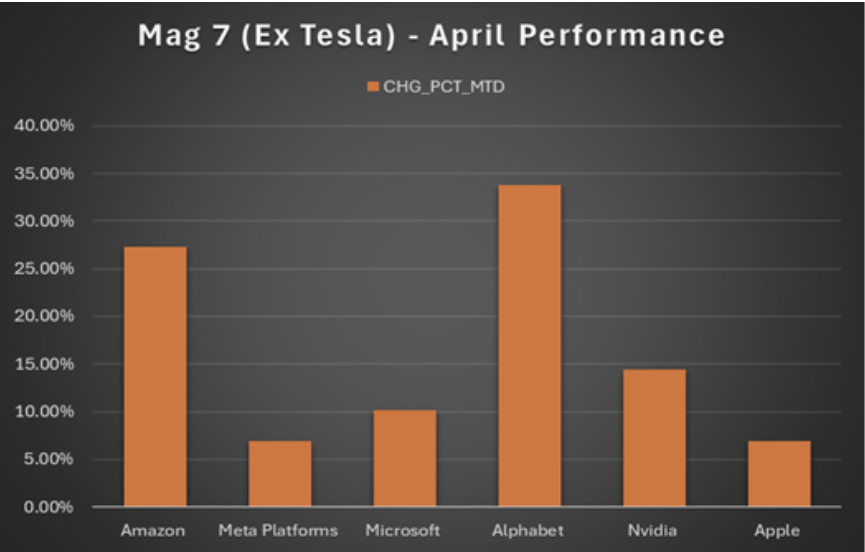
Latest earnings releases confirm that capital expenditure by the largest technology firms continues to grow, driven by the need to train increasingly complex AI models, and equity markets have responded positively.
U.S. Hyperscalers Ratchet Up 2026 Capex Plans Past $700 Billion
Source: Bloomberg, Company Filings
Magnificent Seven (excluding Tesla) – April 2026 Performance
Source: Bloomberg, Company Filings
Semiconductors – April 2026 Performance
Source: Bloomberg, Company Filings
Over the past year, we have consistently emphasised several key investment themes, namely defence, technology, energy infrastructure, commodities (such as gold), mining and financials. More recently, we have added selective exposure to oil and gas within portfolios to reflect evolving supply and demand dynamics.
Defence spending is likely to continue rising, not only in Europe but globally. In the United States, President Trump is currently seeking an additional $200 billion in defence funding for 2026, on top of an existing budget of around $900 billion, alongside proposals for c.$1.5 trillion in fiscal 2027.
Technology investment is approaching a similar scale, with mega-cap technology companies now expected to spend over $700 billion this year. The rapid expansion of AI data centres is driving a sharp increase in electricity demand, with utility firms and governments working alongside the tech sector to expand capacity, much of it funded by private capital.
This level of investment requires vast quantities of raw materials, particularly copper. Given developments in the Persian Gulf, it is likely that investment in fossil fuel will increase as well.
At the same time, government deficits are set to widen as higher defence spending coincides with potential fiscal support aimed at cushioning economies from elevated energy costs. In this environment, we remain cautious on long-duration fixed income, although this view could change if were to see a marked slowdown on global economic growth. Until there is a cessation of hostilities and shipping activity through the Strait of Hormuz increases meaningfully, financial markets are likely to remain exceptionally volatile. Any renewed escalation would risk pushing energy prices higher again, posing a clear threat to global growth.
The price and value of investments and any income that might accrue may fall as well as rise and is not guaranteed. You may not get back the amount of your original investment.
_______
Hear more from the Oakglen experts
Our investment team continue to provide interesting and informative content to help keep you in the loop on recent global news and market trends. See below for some key highlights from around the world which our Chief Investment Officer, Jeff Brummette, has also recently covered:
Read more:
- Central Bank Update: May 2026 – The Energy Shock Part II
Jeff Brummette, Chief Investment Officer
- Q1 2026 Investment Update
Jeff Brummette, Chief Investment Officer
- Central Bank Update: March 2026 – The Energy Shock Part I
Jeff Brummette, Chief Investment Officer
You can read other articles from the team on our News & Insights page.
Sign up below to receive similar content directly into your inbox.
Want to become an Oakglen client?
Get in touch with one of our wealth team via the Contact Us page to hear more about our products and services, and how suitable they are for you and your personal circumstances.