


Global markets continue to shift in response to a mix of economic, political and technological developments, with investors weighing opportunities against persistent risks. Recent months have seen strong performances in certain sectors alongside cautionary signals in others, highlighting the importance of looking beyond headlines to understand the forces shaping returns. From central bank policy to corporate investment trends, there are a number of themes influencing positioning as we move toward the end of the year and into the last quarter. As we enter the Halloween season, it feels fitting that markets carry both treats and a few potential tricks, with our Chief Investment Officer, Jeff Brummette, providing his insights and analysis on what lies ahead.
_______
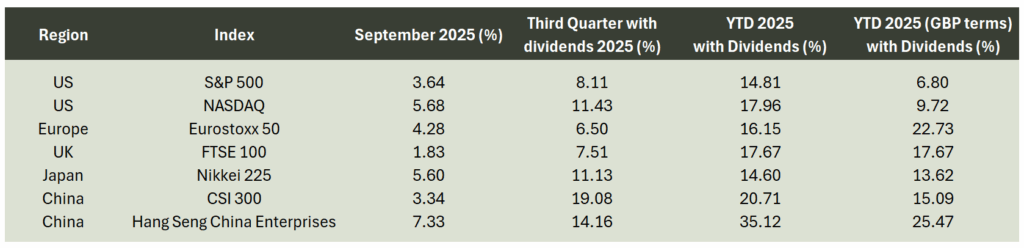
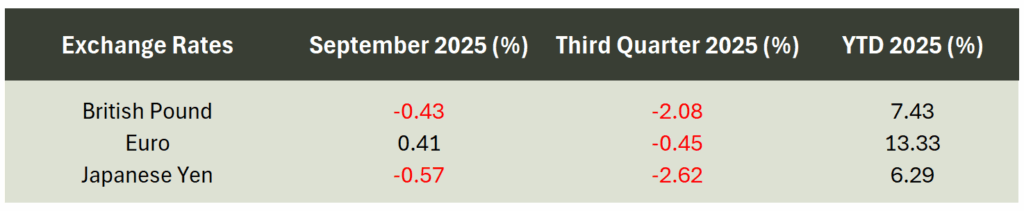
Global equity markets delivered another strong performance in September, with foreign exchange movements continuing to play a significant role in shaping investment returns. Despite the S&P 500 and the NASDAQ hitting new all-time highs during the quarter, a Sterling-based investor would have fared better avoiding U.S. markets this year.
Equity Markets
Source: Bloomberg
Fixed Income Markets

Source: Bloomberg
Alternative Investments Markets
Source: Bloomberg
Currency Exchange Rates
Source: Bloomberg
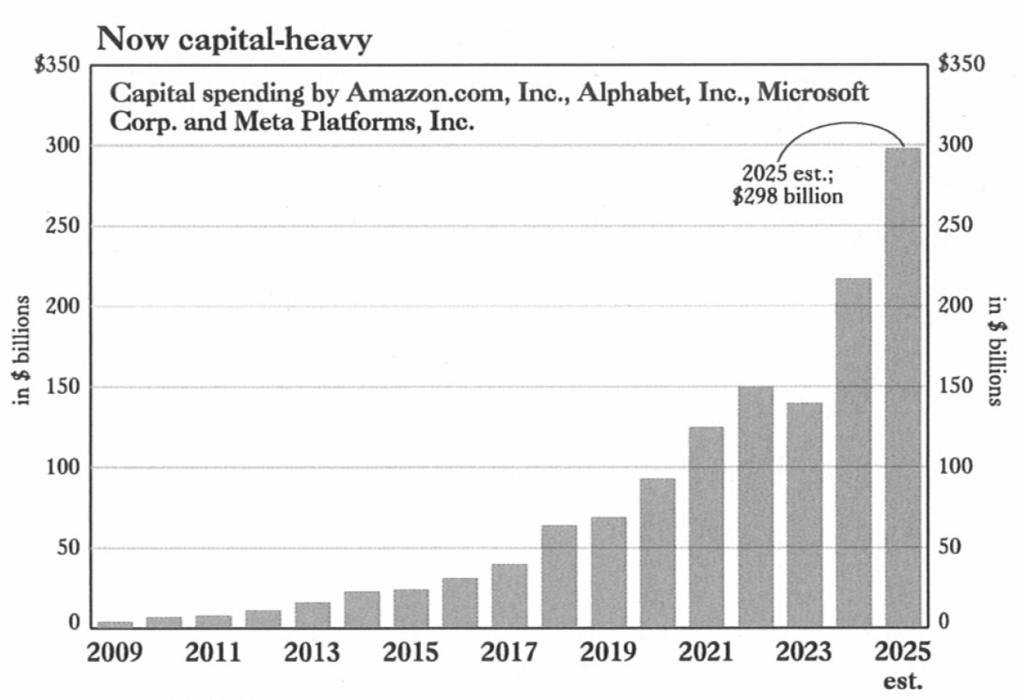
Equity markets benefited from strong second quarter earnings, with limited impact from U.S. tariffs. Share buybacks in the U.S. were also supportive. Meanwhile, capital spending on Artificial Intelligence (AI) by the big tech names continues to accelerate, and some very large deals announced between Nvidia, OpenAI and Oracle boosted valuations across the sector. However, sceptics noted that neither Oracle nor OpenAI currently have the financial resources to execute the deals announced.
Capital Spending by Amazon, Alphabet, Microsoft and Meta
Source: Bain & Co., Inc.
Chinese tech stocks also performed well in the quarter, supported by Alibaba’s announcement of significant AI investments. European defence stocks gained, supported by clear signs of increased regional defence spending. Equities more broadly also responded positively to the U.S. Federal Reserve (Fed) lowering interest rates by 25 basis points and its guidance suggesting that further cuts were on the way.
Looking forward to the fourth quarter, the global macro backdrop remains supportive of risk assets, with expected easing of policy from both the Fed and the Bank of England, while the European Central Bank signalled it may consider additional cuts should inflation or growth trends permit.
Despite some recent softness in the U.S. labour market, consumer spending remains strong, and business investment is also healthy, particularly in the tech and AI space. Credit spreads are at historic lows, and with equity markets sitting at all-time highs, financial conditions remain highly accommodative.
In Europe, defence spending is growing, while the German government has approved a substantial €500bn infrastructure programme. Oil prices remain subdued and appear likely to stay soft unless new sanctions are enforced on the sale of Russian crude.
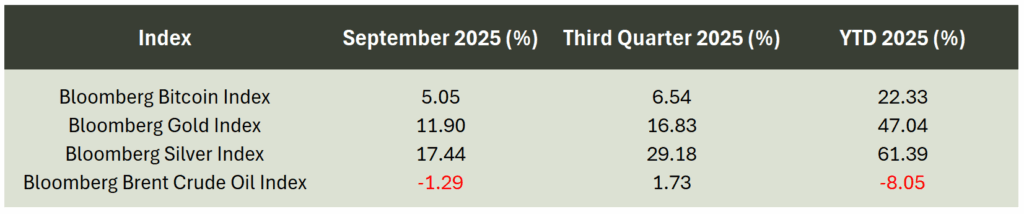
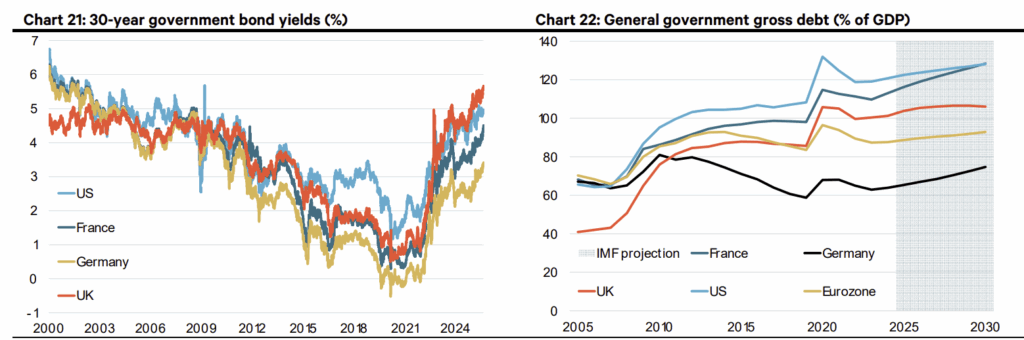
Risks persist, however. Rising tariffs are pushing up import prices, with further increases expected. Weakness in the U.S. labour market could deepen, and while rate cuts would ultimately reduce the pain, they might not forestall a slowdown. Meanwhile, recent gains in gold, silver and other commodities suggest that markets are very concerned about inflation. At the same time, most developed economies are running large fiscal deficits—levels typically associated with periods of recession.
30-Year Government Bond Yields and Gross Debt (% of GDP)
Source: IMF | Daily Data Source: LSEG
Governments (politicians) remain unwilling or unable to reduce spending, leaving inflation and currency devaluation as the way to deal with their ever-growing debt. Since currencies cannot all devalue at the same time – except against gold (and perhaps silver) – this dynamic appears to be unfolding. While cryptocurrencies may benefit on the margins, central banks and institutional investors will primarily buy gold. The longer-dated maturities of most developed country bond markets are evidencing the same concerns as yield curves steepen around the world. Refinancing existing debt into current levels of interest rates is only increasing the burden on most governments’ budgets. When this becomes a crisis is not predictable, but it is inevitable without substantial reductions in entitlements in most Western nations. Yet, in the near term, fiscal restraint is absent from policy agendas.
We continue to prefer non-U.S. assets, with a particular focus on European defence, infrastructure and financials. We are participating in the AI spend not only in the U.S. but also in China, while exposure to mining remains a significant contributor to performance in our portfolios. We are closely monitoring signs of further slowing in the U.S. economy and remain ready to adjust our positioning as necessary.
The price and value of investments and any income that might accrue may fall as well as rise and is not guaranteed. You may not get back the amount of your original investment.
_______
Hear more from the Oakglen experts
Our investment team continue to provide interesting and informative content to help keep you in the loop on recent global news and market trends. See below for some key highlights from around the world which some of the investment management team have recently covered:
Read more:
- September 2025 Investment Summary
Jeff Brummette, Chief Investment Officer
- Central Bank Update: September 2025
Jeff Brummette, Chief Investment Officer
- A Merger of Equals: Anglo American and Teck Resources Combine
William Lamond, Investment Director
You can read other articles from the team on our News & Insights page.
Sign up below to receive similar content directly into your inbox.
Want to become an Oakglen client?
Get in touch with one of our wealth team via the Contact Us page to hear more about our products and services, and how suitable they are for you and your personal circumstances.