

_______
The 1st August deadline for trade deals with the U.S. is rapidly approaching. At the time of writing, President Trump has just announced a deal with Japan with tariffs set at 15%. Japan has pledged to open its markets to U.S. rice and other agricultural products and vowed to invest $550 billion into the U.S.
Markets have responded positively to the news, with the Japanese Nikkei 225 Stock Index rallying nearly 4%. It appears that, in the eyes of the market, a certain 15% tariff is preferrable to the 25% tariff Trump recently threatened Japan with. Japanese car manufacturers saw their shares surge on the day, with Toyota Motors up over 14%. Even German carmakers have rallied, as markets extrapolated that the European Union (EU) might secure a similar deal to Japan’s 15% tariff rate.
No one has asked U.S. consumers how they will feel about the prospect of imported car prices increasing by 15%.
The U.S. has also agreed deals with Vietnam at (20%), Indonesia (19%), and the UK (10%). Negotiations are ongoing with China and the EU. The U.S. Treasury Secretary, Scott Besant, has hinted that China may receive a further extension so a deal can be worked out.
Tariffs are already in place on specific commodities; steel and aluminium at 50%, copper set to join them on 1st August. Trump has also hinted at tariffs on pharmaceuticals will be coming. The U.S. imports nearly 40% of the copper it consumes, and domestic copper mines lack the capacity to significantly increase their output. Copper is also used across all industries, so this will inevitable be reflected in prices.
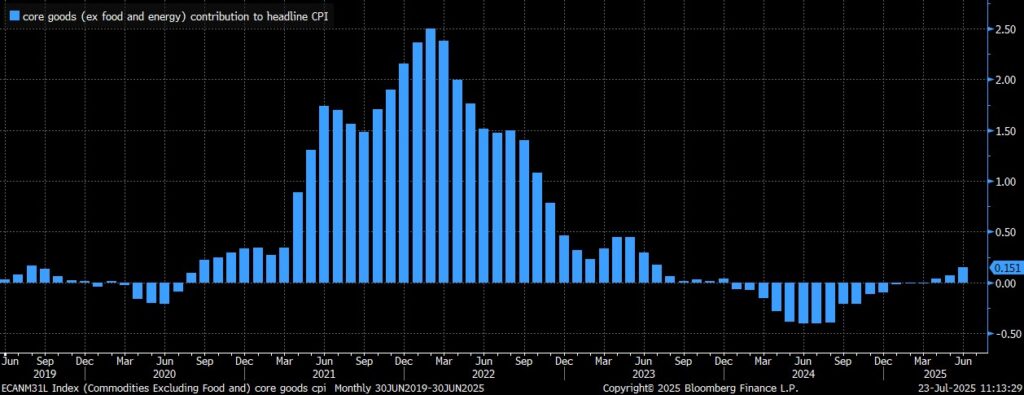
It appears that tariff rates may settle between 15-20%. U.S. businesses and consumers will bear much of this burden. In its latest quarterly report, General Motors cited that tariffs reduced their earnings by 35%. The most recent U.S. inflation data showed goods prices now rising, after a year of goods price deflation.
Core Goods Contribution to Headline CPI Monthly
Bloomberg Finance L.P.
We are only just beginning to see the impact of tariffs on inflation and consumer behaviour in the U.S. Consumers are still unhappy about the overall rise in the price level from the pandemic. They are going to be further aggravated by Trump’s tariffs. The U.S. imports over $3.3 trillion in goods that would be subject to tariffs. At a 15% rate, that equates to $495 billion – an effective tax increase of 1.5% of GDP.
Businesses will also react. U.S. firms have become highly adept at controlling costs. When faced with rising input prices, they are likely to react by raising output prices and/or cutting costs through workforce reductions.
Several significant legal challenges to President Trump’s tariffs remain ongoing. The Court for International Trade vacated Trump’s use of the International Economic Emergency Powers Act (IEEPA) to implement tariffs. Trump appealed and received a stay to that ruling pending an appeal. The appeal will be heard next week in the Federal Circuit Court of Appeals. If this court upholds the original judgement, many of the trade deals may have to be scrapped and tariffs refunded. Trump would likely appeal to the U.S. Supreme Court, although there is no guarantee that the Supreme Court would choose to hear the appeal. There are several similar cases that will be heard this fall.
We are unlikely to have clarity on tariffs for some time.
_______
Hear more from the Oakglen experts
Our investment team continue to provide interesting and informative content to help keep you in the loop on recent global news and market trends. See below for some key highlights from around the world which some of the investment management team have recently covered:
Read more:
- H1 2025: Discretionary Investment Management Service Update
Myles Renouf, Senior Investment Manager (Jersey)
- July 2025 Investment Summary
Jeff Brummette, Chief Investment Officer
- The NATO Summit at the Hague: Defence Spending Hike
William Lamond, Investment Director (Jersey)
You can read other articles from the team on our News & Insights page.
Sign up below to receive similar content directly into your inbox.
Want to become an Oakglen client?
Get in touch with one of our wealth team via the Contact Us page to hear more about our products and services, and how suitable they are for you and your personal circumstances.